







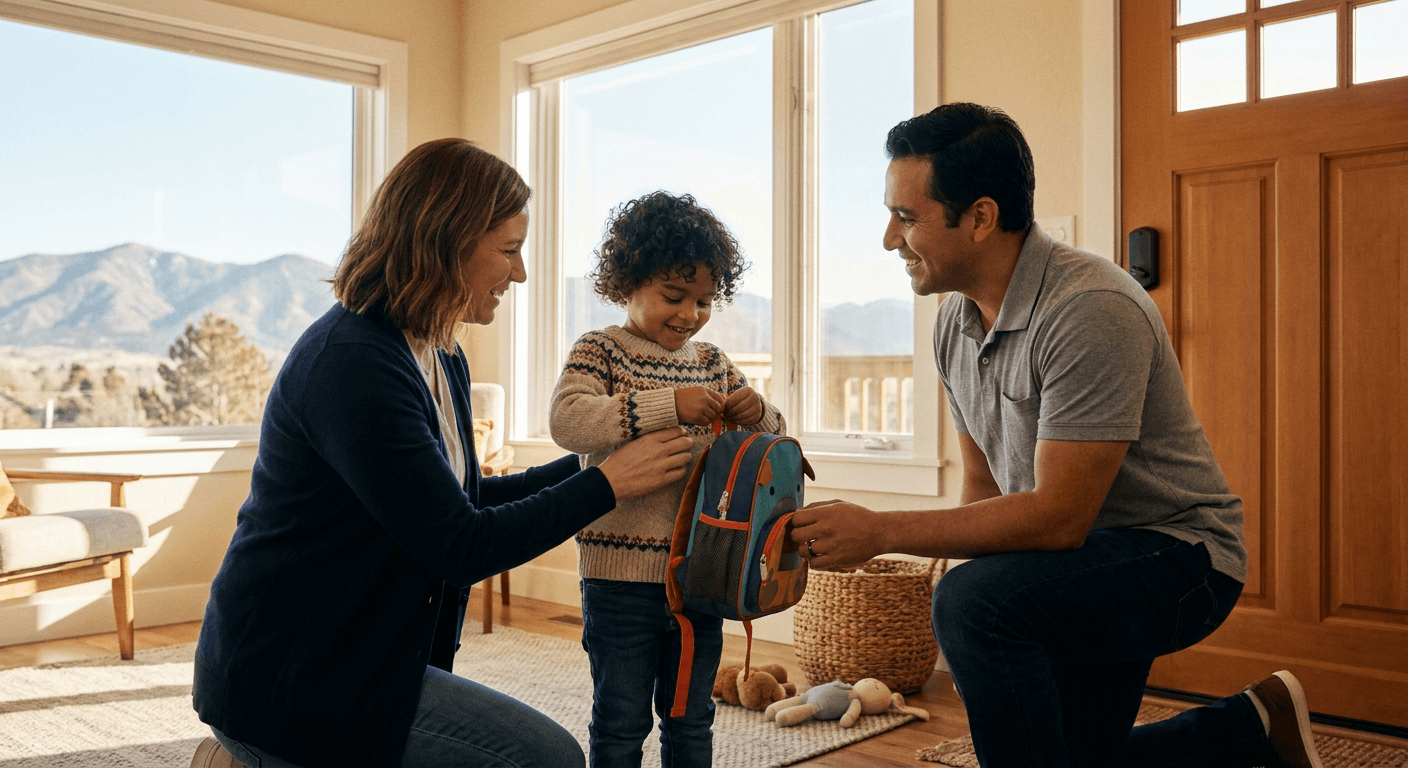
If your child is getting in-home ABA now and kindergarten is a year away, it is completely normal to feel hopeful and anxious at the same time. Many Colorado families are trying to answer the same questions: What should we focus on first? How much should happen at home versus in ABA? And how do we make the move into school feel steadier, not rushed?
This guide is built for that season. Instead of treating kindergarten readiness like a pass-or-fail label, it looks at the year ahead as a time to build the everyday skills that help a child participate in class, move through routines, and lean on the right supports. The goal is not perfection by the first day of school. It is a more thoughtful handoff, clearer priorities, and a steadier path toward independence.
What kindergarten readiness means in this transition
In this transition, readiness is less about checking every box and more about helping your child take part in classroom life in ways that feel realistic and supportive. That may include following simple routines, moving between activities, handling short periods of group instruction, asking for help, or using familiar supports with new adults. It does not mean a child has to stop needing accommodations or support.
That distinction matters. Many autistic children begin kindergarten with visual supports, extra transition help, or other accommodations and still have a positive start. Readiness is not about looking like every other child in the room. It is about growing access to the classroom.
ABA can play a helpful role here, especially when the work stays rooted in real life. A child may show a skill during a familiar in-home session, but kindergarten will ask them to use that same skill with more noise, more waiting, more people, and less one-to-one support. That is often where families need the most clarity.
For most children in the year before kindergarten, the highest-impact areas include:
- following simple group routines
- communicating needs to less-familiar adults
- moving through transitions with less stress
- handling bathroom routines when developmentally appropriate
- beginning to use self-advocacy or recovery supports
- tolerating short periods of waiting, shared attention, and group pace
A child does not need to do all of this perfectly before school starts. What matters most is building a plan that matches your child, not forcing your child to match a rigid timeline.
A 12-month transition plan
12 to 9 months before kindergarten: choose the priorities that matter most
This is the best time to step back and decide what will make the biggest difference in daily school life. It is tempting to work on everything at once, especially when kindergarten starts to feel close. In practice, families usually make better progress when they narrow the focus.
For one child, the biggest priorities might be bathroom independence, asking for help, and moving through a visual routine. For another, it might be tolerating group instruction, recovering after transitions, and taking direction from a less-familiar adult. The right priorities depend on the child in front of you.
This is also the time to get specific about the current baseline. Ask practical questions:
- Can your child follow a short routine with visual support?
- Can they move from one activity to another without heavy prompting every time?
- Can they wait briefly, participate in a shared activity, or communicate discomfort before becoming overwhelmed?
- Are they using skills only with familiar people, or across settings?
Try to track what you can observe, not just general impressions like “doing better” or “not ready yet.” Clear, everyday observations make it easier to set goals that mean something in real life.
Just as important, keep expectations grounded. The year before kindergarten should create momentum, not constant pressure. A steady plan usually helps more than an aggressive one.
9 to 6 months before kindergarten: help skills travel beyond the therapy setting
Once you know the priorities, the next step is helping those skills show up outside a familiar ABA session. A child may clean up well with a therapist in the living room, then struggle to do the same after snack, at a park, or during a more distracting routine. That does not mean the skill is missing. It usually means the skill still needs to generalize.
This part of the year is a good time to practice routines that feel more like school, such as:
- arrival and departure routines
- short cleanup routines
- following a visual sequence
- snack or mealtime flow
- brief group activities
- responding to another adult’s direction
- waiting for a turn during play or movement
Keep the practice simple and repeatable. A few minutes of meaningful practice inside daily life often goes further than long drills. A short circle-time-style activity at home, lining up before leaving, or moving through a shared cleanup routine can build more useful confidence than turning every evening into a school simulation.
Pay attention to your child’s response as you add new expectations. If you start seeing more avoidance, more prompting, shutdown, or distress, that is useful information. It may mean the skill needs a smaller step, a different setting, or a slower pace.
6 to 3 months before kindergarten: focus on practical independence and classroom tolerance
As kindergarten gets closer, it helps to shift toward the skills that shape the school day in a very practical way. These are often the moments families worry about most because they affect how a child gets through the day, not just how they perform in a session.
This may include:
- communicating basic needs
- managing bathroom routines when appropriate
- handling shoes, outerwear, lunch items, or backpack steps
- moving between activities with less adult support
- tolerating short periods of group pace and classroom noise
- accepting help from adults outside the ABA team
A useful question in this stage is: Can my child do this only when the setting is quiet and predictable, or can they do it when things feel busier and less flexible? Kindergarten usually brings more sensory input, more transitions, and more variation from one moment to the next.
This stage is also where families sometimes realize they need to simplify. If your child becomes more fatigued, more prompt-dependent, or less regulated as goals increase, it may be time to reduce the number of targets and stay with the ones that matter most for participation. That is not falling behind. It is adjusting the plan so the work stays useful.
Short, natural practice tends to be more effective than long academic push sessions at home. The goal is to build steadier independence in the moments that matter, not to rehearse an ideal school day from start to finish.
3 to 0 months before kindergarten: get the handoff ready
In the final stretch, the focus shifts again. Skill-building still matters, but now the handoff matters just as much.
Think about the first few weeks of school. What would help your child most? Maybe it is smoother morning arrival. Maybe it is bathroom transitions. Maybe it is being able to ask for help before frustration builds. Choose a few first-month priorities instead of trying to prepare for every possible challenge.
This is also a good time to organize a short, practical summary for the adults who will support your child. That summary might include:
- what helps your child regulate
- what tends to make transitions harder
- how they usually communicate discomfort, help-seeking, or avoidance
- which supports have been most effective
- what the family most wants school staff to understand early
Keep summer preparation realistic. Visiting a playground near the school, walking into unfamiliar buildings, practicing a backpack routine, or using a visual countdown for upcoming changes can all help. What usually helps less is turning every day into nonstop preparation.
If your child is showing more stress than confidence as school gets closer, slow the pace. Stabilizing a few key routines is often more valuable than adding more demands. Kindergarten is a transition, not a final exam.
A simple way to organize the year: the Roots-to-Room Readiness Map
Routines to generalize first
The routines most worth generalizing are usually the ones that shape participation from the moment a child enters the building. That may include arrival, cleanup, snack, bathroom flow, group sitting, and following another adult’s direction. These are the routines that carry a lot of weight during a school day.
Regulation under classroom demand
A classroom can place very different demands on regulation than a one-to-one home session. Noise, waiting, denied access, peer movement, and a faster group pace can all change how a skill looks. It helps to think not only about whether a child can complete a task, but how they recover, re-engage, and use support when the environment becomes harder.
Relationships beyond the ABA team
A strong transition plan also makes room for the emotional side of the shift. Kindergarten means more adults, more peers, and less familiarity. Many children need time to accept help from new people, respond to their cues, and feel safe in a wider circle. That is part of readiness too.
Real-world independence markers
Some skills matter because they make everyday participation more possible. Communicating needs, moving through transitions, handling toileting routines when appropriate, asking for help, and participating without constant one-to-one prompting are all practical markers. They are not a perfection checklist. They are signs that a child is gaining more access to the day.
Team handoff decisions
Families and clinicians often have more information than a school team needs on day one. The goal is not to hand over everything. The goal is to pass along the details that make support more coherent. What works? What tends to create friction? Which supports are most helpful? What does the family want the school team to understand from the start? Keep the handoff clear, concise, and usable.
Coordinating home, ABA, preschool, and kindergarten teams
The most helpful transition plans usually come from role clarity, not from one person trying to carry the whole process.
Parents often notice where routines break down in daily life. BCBAs can help define measurable goals and track whether progress is holding across settings. Preschool teams can offer useful perspective on group participation, transitions, and how the child responds outside the home. Kindergarten staff need practical information that helps them support participation early, without being overwhelmed by too much detail.
Useful handoff information may include:
- supports that reliably help with transitions or regulation
- common stress points around waiting, noise, or routine changes
- how the child typically communicates discomfort or asks for help
- two or three realistic first-month priorities
- what has already been working across home, community, or preschool routines
When talking with teachers, collaboration usually goes further than urgency. It is often more useful to say, “Transitions go more smoothly when she can see what comes next,” than to ask school staff to recreate a full home program. ABA can support the transition, but school teams will still need room to use their own expertise, structure, and supports.
Kindergarten Transition Coordination Checklist
Use this as a simple planning tool during BCBA reviews, preschool conferences, spring planning, and kindergarten handoff meetings.
12 to 9 months before kindergarten
- choose the top three readiness priorities
- document baseline observations across routines, communication, transitions, and group participation
- separate what should be practiced at home, targeted in ABA, or planned for school coordination
9 to 6 months before kindergarten
- practice arrival, cleanup, snack, and visual-routine skills in more than one setting
- build short periods of group participation into daily life
- help your child get more comfortable with less-familiar adults in low-pressure situations
6 to 3 months before kindergarten
- focus on communication for needs, bathroom routines when appropriate, dressing steps, and moving between activities
- see whether skills hold up in busier settings, not only quiet ones
- watch for fatigue, overload, or signs the plan needs to slow down
3 to 0 months before kindergarten
- prepare questions and priorities for the school team
- create a short handoff summary with effective supports, common triggers, and first-month goals
- decide which routines to preview before school starts and which demands can wait
FAQ
How does ABA therapy prepare children for kindergarten?
ABA can support the skills that matter in a classroom, including routines, communication, transitions, and everyday independence. In the year before kindergarten, the most helpful work is usually not just teaching a skill once. It is helping the child use that skill in different settings, with different adults, and under more typical classroom demands.
What skills should a child build in ABA before starting kindergarten?
That depends on the child, but the highest-impact areas often include transitions, communication for help or discomfort, short periods of group tolerance, bathroom routines when developmentally appropriate, adaptive skills, and regulation support. The best priorities are the ones that make classroom participation more possible, not simply the ones that are easiest to measure.
How can parents support the transition from in-home ABA to school?
Parents can support the transition by choosing a few meaningful priorities, practicing routines in daily life, sharing clear observations with the ABA team, and preparing early for school conversations. It also helps to pace the process carefully. When a child is overwhelmed by too many new expectations, simplifying the plan is often more productive than adding more.
What does kindergarten readiness look like for autistic children?
Kindergarten readiness looks like growing access to the classroom, not meeting one fixed standard. A child may still need accommodations, visual supports, extra transition help, or time to adjust and still be ready to begin. Functional communication, regulation, participation, and support needs matter more than appearing typical.
How do parents coordinate ABA goals with a kindergarten teacher or school team?
Start with the information that will help the first few weeks go more smoothly. Share what supports work, what patterns to watch for, and which priorities matter most right away. Keep the handoff practical and manageable. The goal is to help the school team understand the child, not hand over a therapy program for the classroom to copy.
Colorado planning notes
For Colorado families, earlier planning is usually easier than last-minute planning. District conversations, preschool-to-kindergarten handoffs, and evaluation timelines can all take time. If you think your child may need school-based supports, it helps to start asking about timelines and documentation well before summer.
At the same time, it helps to keep the process grounded. You do not need to turn the year before kindergarten into a full-time project. A steadier approach usually serves families better: focus on a few functional goals, coordinate early, and give your child room to grow into new routines. That kind of planning stays rooted in care and keeps the long-term goal in view, which is greater independence across home, school, and community.
