







If you’ve been told to “practice requesting” or “work on waiting” between sessions and thought, Okay, but what does that actually look like at home? you’re not alone. Most families are trying to fit therapy goals into real life: meals, school bags, siblings, bedtime, and the general rush of the day.
The goal is not to turn your home into a second therapy room. It is to find one small, realistic moment where your child can practice a skill with support. Done well, between-session practice should feel steady, respectful, and doable.
In plain language, requesting means asking for something in a way your child can manage right now, whether that’s a word, gesture, sign, picture, or device. Reinforcement is what makes the skill worth trying again, like getting the snack, hearing specific praise, or moving on with the routine. Generalization means the skill starts showing up in everyday life, not just during therapy.
That’s what between-session practice is for: helping a skill carry over into the moments that matter. Not perfection. Not nonstop correction. Not pressure.
Why Between-Session Practice Helps (Without Turning Home Into Therapy)
The point of between-session practice is carryover, not homework in the school sense. Your child is not being asked to perform on cue all day. They are getting a few chances to use a skill in familiar routines, with people they trust.
That’s why one small win at snack time can matter so much. Asking for help with a wrapper, waiting a few seconds for juice, or following one simple direction during a normal routine is real-life practice. It is also often more sustainable than a long practice block that leaves everyone frustrated.
It usually helps to keep the focus narrow. If your BCBA gives you several goals, you do not have to squeeze all of them into every part of the day. Pick one target and one routine first. That is often where the best progress starts.
You do not need to sound like a clinician, either. Clear, simple language is enough. For younger children, or children who are early in communication, that may mean shorter wait times, more modeling, and fewer words. The goal is not polished performance. It is useful practice.
The ROOTS Routine Loop
R: Read the goal in plain English
Translate the homework into one simple action. “Practice requesting” might mean helping your child ask for a snack item. “Work on waiting” might mean pausing for three to five seconds before opening the door. “Follow one-step directions” might mean “put your shoes by the door when asked.”
If the goal still feels vague, ask for clarification instead of guessing. You can say, “Can you show me what this should look like at home?” or “Which routine would be best for this?” That keeps the clinical target clear while making it easier to use in real life.
O: Observe one natural moment
Choose a routine that already happens every day and already gives your child a reason to use the skill. Snack time creates natural chances to request. Shoes create a built-in transition. Bath time often includes simple directions and familiar items. Bedtime gives you a predictable sequence.
For younger children, predictable routines usually work best. If a moment is already rushed, noisy, or stressful, it may not be the right place to start. A calmer part of the day is often more useful than trying to force practice into a hard moment.
O: Offer one prompt, not a whole lesson
Use one short cue, one gesture, one model, or one pause. Then wait. That might sound like, “Say juice,” “Shoes on,” “Your turn to ask,” or simply holding up two options and pausing.
You are looking for one supported rep, not a full lesson. If your child tries, gestures, approximates, or gets part of the way there, that can still count as meaningful practice. For children who are tired, dysregulated, or early learners, keep your prompt lighter and your expectations smaller. If the moment starts to feel like a struggle, step out of teaching mode.
T: Thank and reinforce the attempt
A win does not have to be perfect. If your child points to the snack instead of saying the whole word, tolerates a short wait, or accepts help with shoes after one prompt, that is still progress.
Reinforcement should fit the moment. At snack time, it may be getting the snack. During a transition, it may be moving on quickly once the step is done. Sometimes it is specific praise like, “You asked for help,” or “You waited. Nice job staying with me.” Keep it supportive and steady, not overly intense.
S: Share patterns with the BCBA
You do not need to come back with a detailed data sheet. What helps most is noticing patterns. Which routine worked best? Did your child respond better to a gesture than a verbal prompt? Was bath time too hard because they were already tired? Did snack time go smoothly because motivation was built in?
That kind of feedback gives the BCBA something useful to work with. Your job is not to be the clinician. It is to notice what happened in real life and share what you saw.
Five 60-Second Practice Moments That Fit Real Life
Snack time
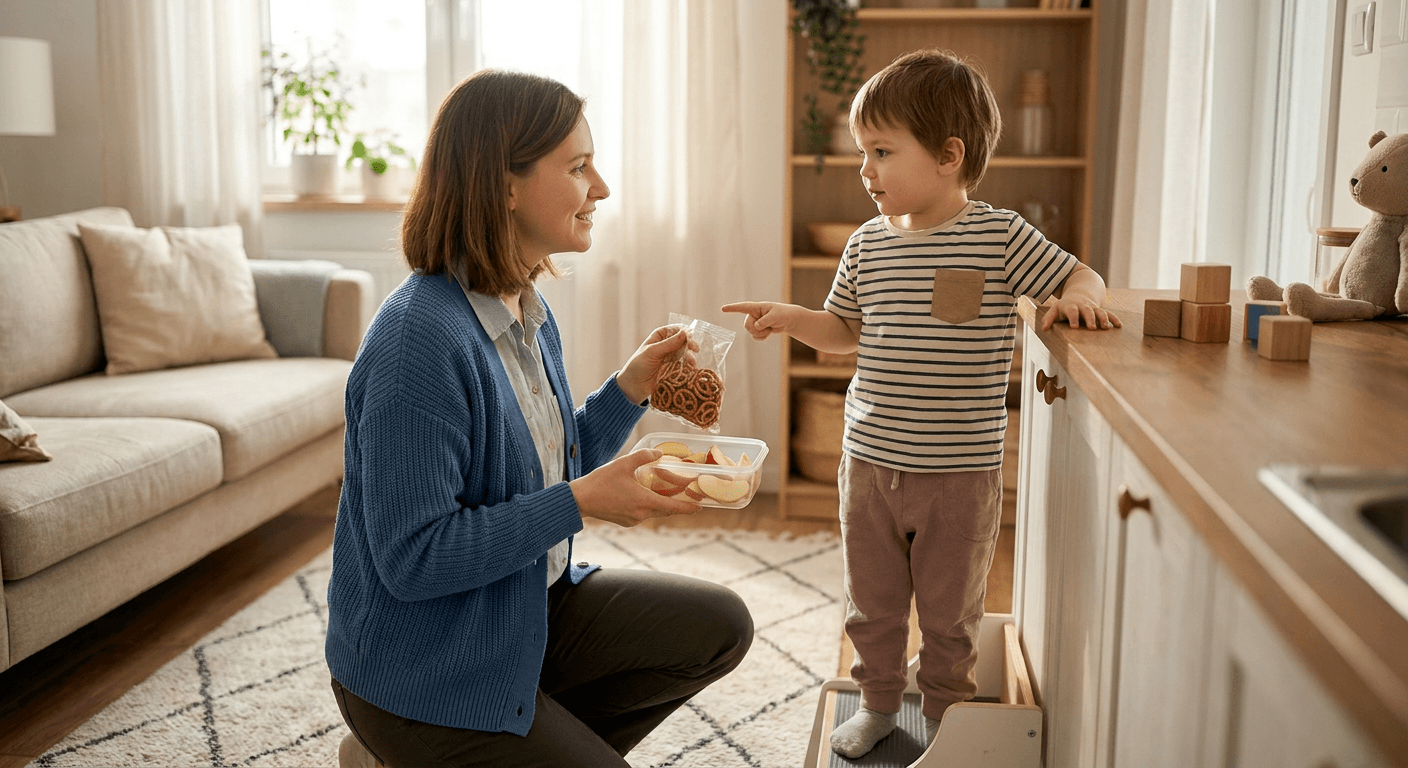
Snack time is one of the easiest places to work on requesting, choice-making, waiting, and simple communication. Put two options in view, hold one back briefly, and pause. You might say, “Do you want crackers or apple?” or model one word like “cracker” and wait.
For younger children or early communicators, a point, picture, gesture, or one-word attempt can count. Success might look like reaching for the right item, making a sound approximation, or tolerating a short pause before getting the snack. Stop if the moment becomes stressful. Do not turn hunger into leverage or hold back essentials for long periods.
Getting shoes on
Shoes are a natural place to practice following one direction, asking for help, tolerating a transition, or waiting briefly before heading out. Keep your language simple: “Shoes on,” “Bring shoes,” or “Help?” if the goal is requesting assistance.
A good win here might be sitting down after one cue, handing you a shoe, or lifting a foot for help. Reinforcement can be immediate movement into the next part of the routine: going outside, getting in the car, or hearing, “You did it. Time to go.” If transitions are already hard, do not add extra correction points just because the target is available.
Getting into the car
The car routine can support waiting, transitions, and simple directions, but it should stay low pressure. Preview the step, then keep the expectation minimal: “First buckle, then go,” or “Hands on seat, then I help.”
For children who struggle with transitions, a short preview often works better than a lot of talking. Success may look like tolerating the move to the car, sitting with one prompt, or waiting a few seconds for the next step. If safety or time pressure is the main issue, skip the practice and get everyone where they need to go.
Bath setup
Bath time offers chances to request items, follow one-step directions, and build daily living participation. You might hold up the towel and say, “Towel or toys?” or give one clear direction such as, “Put pajamas here.”
This routine can work well because the items are familiar and right in front of your child. A useful win might be asking for bubbles, handing over the washcloth, or following one short direction without repeated prompting. If bath time is already sensory-heavy or stressful, focus on calm participation rather than perfect execution.
Bedtime
Bedtime can support calming, communication, and one small independence step, but only if you keep it light. Think predictable sequence, fewer words, and one target. That could be asking for a book, following “lights off,” or helping place one item where it belongs.
For younger children, consistency matters more than complexity. A successful rep might be choosing between two books, tolerating one brief direction, or using a gesture to ask for one more hug. If bedtime is already a flashpoint, scale the target down and prioritize regulation over practice.
What Not to Do Between ABA Sessions
Do not try to work on everything at once. Do not turn every interaction into a correction opportunity. Do not chase perfect compliance. And do not keep pushing just because the homework was assigned.
Home should still feel like home. Children need space to rest, play, connect, and move through routines without feeling constantly tested. If between-session practice starts to feel like nonstop drilling, it is usually a sign that the target, timing, or prompt needs to change.
It also helps to look at resistance with curiosity. Sometimes a child is tired after session. Sometimes the routine is too busy. Sometimes the prompt is unclear. Sometimes the target just does not fit that moment. A steady, neurodiversity-affirming approach usually gets you further than a power struggle.
When to Stop, Reset, or Ask the BCBA for More Guidance
Stop and reset if your child is escalating, dysregulated, clearly fatigued, or no longer meaningfully engaged. Stop if the house is too chaotic for the moment to be useful. Stop if you notice yourself repeating the same prompt over and over without getting a workable response.
Ending early is not giving up. It is protecting the quality of practice and the parent-child relationship. Especially for younger children or children with lower tolerance, one supported attempt may be enough for the day.
Ask the BCBA for more guidance if the homework is too vague, if you are not sure what counts as success, or if the routine you chose is not working. A helpful update might sound like this: “We tried requesting at snack time with a short pause. He pointed twice but got upset when I waited longer. Bath time was harder because he was tired.” That gives your BCBA something concrete to respond to.
One Target, One Moment Carryover Planner
A simple carryover planner can make between-session practice feel much clearer. The point is not to score your child. It is to help you choose one target, one routine, and one realistic way to practice it this week.
Planner skeleton
- Current target: What skill are we practicing in plain English?
- Best daily moment: Which routine already gives a natural chance to use it?
- Exact parent prompt: What will I say, show, or pause for?
- Reinforcement idea: What naturally follows a successful attempt?
- Stop signal: How will I know this is no longer a useful practice moment?
- What to share back with the BCBA: What worked, what did not, and what felt unclear?
- Quick reflection: What went better today? What was harder than expected?
- Next check-in decision: Keep the same routine, switch routines, narrow the target, or pause and reset.
Practical usage notes
Fill this out right after a session or when your child’s goals change. Keep it focused on one target and one routine for the week. If the homework still feels unclear once you write it down, that is your cue to follow up, not improvise.
This kind of planning supports the same grounded, real-life approach Cedar Grove is known for: steady progress, practical routines, and growth that supports independence in the moments that matter.
FAQ
How can I support my child between ABA sessions?
Pick one goal and one routine where that goal fits naturally. Use a short prompt, notice the attempt, and keep the moment brief. Consistency matters more than perfection.
What activities reinforce ABA therapy at home?
Usually, the best “activities” are not extra activities at all. Snack time, shoes, the car, bath setup, and bedtime often work better because the skill already fits the routine.
How much practice between sessions is actually helpful?
Short, repeatable practice is usually more helpful than doing a lot at once. One successful moment in a day can be enough, especially if your child is tired or overloaded.
What should I do if my child resists ABA homework at home?
Reduce pressure, stop if the moment is no longer productive, and look at whether the timing, target, or prompt needs adjusting. Resistance often means something about the setup needs to change.
How can parents practice requesting or communication goals during normal routines?
Start with routines where something your child wants is already part of the moment, like snack, bath items, help with shoes, or choosing a bedtime book. Use one simple prompt and let approximations count.
